Selected work03 / 04 — Case Study
GNU Radio MCP Server - LLM-to-SDR Bridge
An MCP server that lets language models control live GNU Radio software-defined radio flowgraphs through validated tools.
Architecture13 tools over ZMQ + XML-RPC
RoleSystems engineer
StatusOpen source
StackPython · FastMCP · ZMQ · XML-RPC · GNU Radio · Pydantic v2
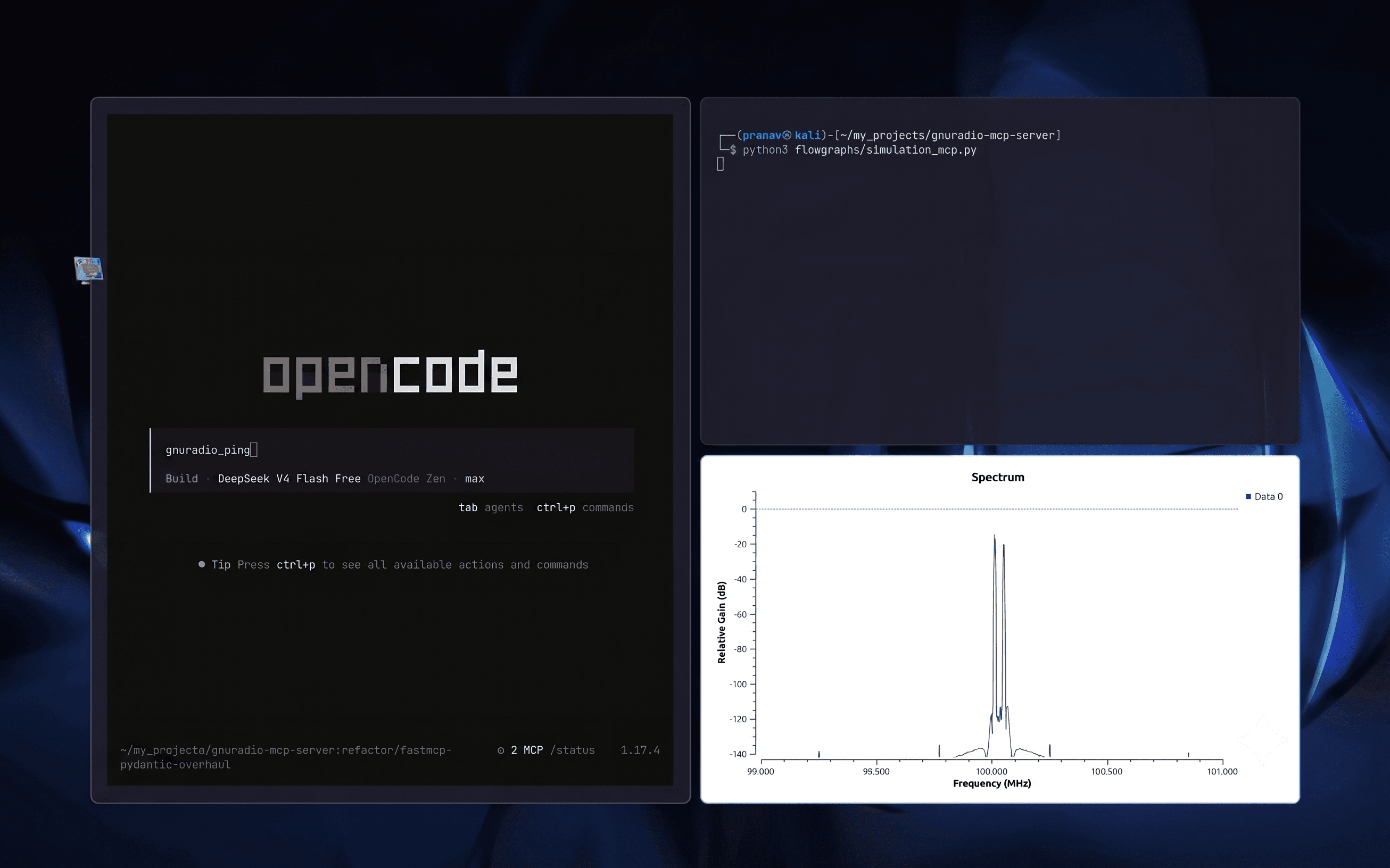 Fig. — Overview
Problem
LLMs can choose tool calls, but RF hardware needs strict validation, lifecycle management, and streaming data paths. The project bridges those worlds without letting hallucinated parameters reach hardware unchecked.
Architecture
Architecture
LLM ClientClaude Desktop or compatible client
MCP ServerFastMCP, 13 validated tools
XML-RPCParameter control
ZMQIQ streaming
GNU Radio FlowgraphSDR pipeline and DSP blocks
Spectrum AnalysisWelch PSD and peak detection
Key Decisions
01
Split command and data transport
XML-RPC is used for control while ZMQ handles streaming IQ data, keeping slow control changes separate from continuous signal samples.
02
Pydantic validates every hardware-facing tool
Tool arguments are checked before they touch GNU Radio so invalid model outputs cannot directly crash or misconfigure the flowgraph.
03
Server lifecycle owns radio resources
The ZMQ context and hardware-facing resources are managed with the MCP server lifecycle to avoid socket leaks and locked SDR devices.
Lessons / Results
- Hardware control requires defensive programming at every boundary.
- Real-time signal streams need different architecture than ordinary request/response web APIs.
- MCP is a useful abstraction when the tool boundary is treated as a safety boundary too.