Selected work04 / 04 — Case Study
RF Watch - Open-Source Real-Time RF Spectrum Monitor
A passive RF spectrum monitor that favors deterministic physical-layer evidence over black-box classification.
RF MonitorPassive spectrum analysis
RoleSignal-processing engineer
StatusOpen source
StackPython · GNU Radio · HackRF One · Signal Processing
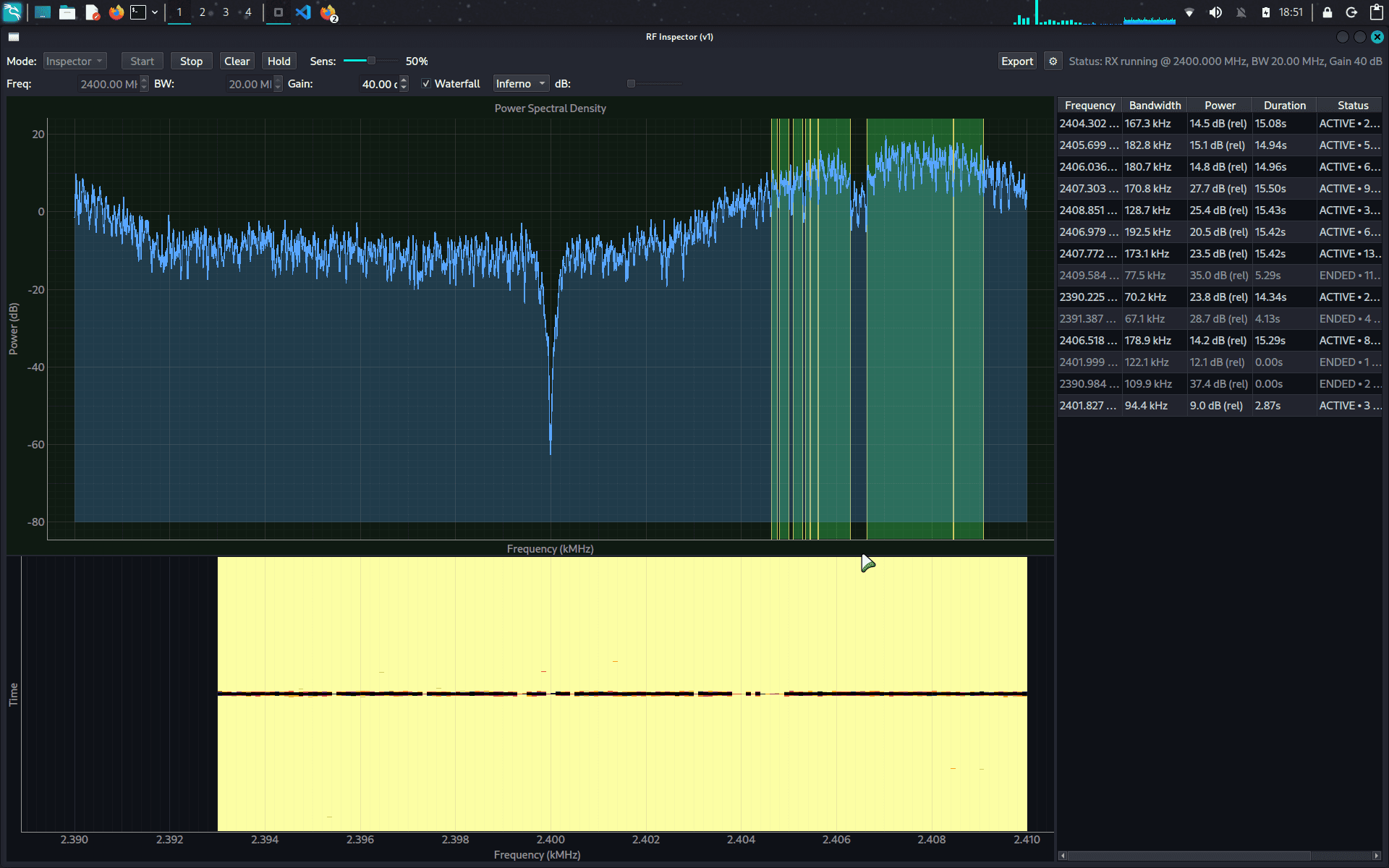 Fig. — Overview
Problem
Anti-drone and RF-monitoring workflows need explainable evidence, not only labels. RF Watch listens passively, extracts spectral features, and surfaces anomalies without transmitting.
Architecture
Architecture
HackRF OneRaw IQ samples
GNU Radio DSPWelch PSD, peak detect, band energy
Feature VectorFrequency, bandwidth, SNR, duty cycle
ClassifierLightweight passive detection
Operator ViewTraceable alerts
Key Decisions
01
Passive-only monitoring
The system listens without transmitting, which keeps the design simpler, safer, and focused on environmental evidence.
02
Welch PSD over naive FFT snapshots
Averaged spectral estimates reduce noise and create steadier features for downstream detection.
03
Traceable features over opaque certainty
The interface should help an operator inspect why something looks unusual instead of only showing a label.
Lessons / Results
- RF systems need deterministic observability because the environment changes constantly.
- A simple model with good features is often more useful than a complex model with weak signal processing.
- Physical-layer systems make software abstraction mistakes visible very quickly.